

/
RSS Feed
a place for us to share ideas, talk about life, and learn together.
Grace Abounds
A Sermon Series Through the Book of Galatians
“No One Is Beyond the Reach of His Amazing Grace”
Galatians 1:10-24
Introduction
There once was a man who was searching for his keys under the street light. His friends came along stopped and asked him “Exactly, where did you drop your keys?” “In my house,” the man answered. “In your house? Then why are you looking out here?” “Because the light is better out here.”
You are not going to find what you are looking for unless you are looking in the right place. Most people are looking for spiritual life in the wrong place. Originally the Galatian people knew where to find the key to salvation. They had heard Paul’s message and had been saved by putting their faith in Jesus Christ. Now they were confused. They began to listen to legalists who said they needed two keys to be saved – faith and good works. Confused the Galatians were looking for the key to salvation and Christian maturity in the wrong place.[1]
Prayer
Paul’s Defense of His Authority to Share the Gospel (vv.10-11)
10 For am I now seeking the approval of man, or of God? Or am I trying to please man? If I were still trying to please man, I would not be a servant of Christ.
Paul’s critics were saying that Paul had watered down what it takes to please God, or to be right with him (justification) by removing the requirement to follow the law. Paul then refutes this claim by asking two questions (v. 10). His motive is to please God and not men.
Regarding Paul following the earthly traditions of man, or looking religious to others, Paul says, Philippians 3:4-6 “. . . If anyone else thinks he has reason for confidence in the flesh, I have more: 5 circumcised on the eighth day, of the people of Israel, of the tribe of Benjamin, a Hebrew of Hebrews; as to the law, a Pharisee; 6 as to zeal, a persecutor of the church; as to righteousness under the law, blameless. 7 But whatever gain I had, I counted as loss for the sake of Christ.”
If salvation was about keeping rules, and appearing religious Paul had accomplished that. He walked away from trying to appear a certain way to men, and is now seeking the approval of God alone. You can’t follow the rules of this world, to be liked by the people of this world, and preach the gospel (and please God at the same time).
Martin Luther said, “. . . For the world finds nothing more irritating and intolerable than hearing its wisdom, righteousness, religion, and power condemned . . . For if we denounce men and all their efforts, it is inevitable that we quickly encounter bitter hatred, persecution, excommunication, condemnation, and execution.”[2]
Have you ever heard the saying, “God really doesn’t mind what you believe as long as you are sincere?” Paul was incredibly sincere against those he saw as the enemy of God – even to the point of killing them. Emotionally Paul was invested fully in the belief that Jesus followers had to be stamped out. His mind was not going to be changed by a reasonably stated argument. Nothing was going to convince him that what he was doing was wrong – God had to do it. He was violent, a persecutor, and an arrogant man.
God can change the heart of any man.
11 For I would have you know, brothers, that the gospel that was preached by me is not man’s gospel.
No one led Paul to the Lord. He did not read a gospel tract, he did not go forward and talk to a preacher at the end of a worship service. He did not receive it, and he was not taught the gospel – then how does he know the gospel? Paul doesn’t argue proofs from theology – he simply tells his story. “He argues for the divine origin and nature of the gospel by describing the profound change the gospel has made in his life.”[3]
Paul Was an Enemy of the Gospel – Paul’s Need For Grace (vv. 12-14)
12 For I did not receive it from any man, nor was I taught it, but I received it through a revelation of Jesus Christ. 13 For you have heard of my former life in Judaism, how I persecuted the church of God violently and tried to destroy it. 14 And I was advancing in Judaism beyond many of my own age among my people, so extremely zealous was I for the traditions of my fathers.
“For you have heard of my former life . . .”
Paul did not make himself an apostle, and the gospel did not come from men – (v. 1) “Paul, an apostle — not from men nor through man, but through Jesus Christ and God the Father . . .” Paul points to his own life as proof that God changes lives. 2 Corinthians 5:17 “Therefore, if anyone is in Christ, he is a new creation. The old has passed away; behold, the new has come.”
Paul fully understood what the false teachers were pushing – he himself had taught and believed the same thing before he came to know Christ. He was zealous for this belief to the point of trying to stamp out the early Christian church (Acts 7).
(v. 13) “I persecuted the church of God violently and tried to destroy it,” – His use of the word “destroy” stresses that in his former life his actions against the church were exceptionally violent and that he had intended to obliterate it. Acts 8:3 “But Saul was ravaging the church, and entering house after house, he dragged off men and women and committed them to prison.” He was “breathing threats and murder” against the church (9:1).
Paul was sincere in his beliefs – he persecuted other people who thought differently than he did, he was violent and destructive. He was extremely zealous for the traditions of his beliefs.
Paul Moved From Persecutor to Preacher – Paul Receives Grace (vv. 15-17)
15 But when he who had set me apart before I was born,[4] and who called me by his grace, 16 was pleased to reveal his Son to me, in order that I might preach him among the Gentiles, I did not immediately consult with anyone; 17 nor did I go up to Jerusalem to those who were apostles before me, but I went away into Arabia, and returned again to Damascus.
“But when he . . . called me by his grace, . . .”
So how did Paul go from zealously persecuting the church to being a top leader in its ranks? Jesus appeared to Paul on the road to Damascus and he was saved (Acts 9). God called Paul (destined before he was even born) to preach the gospel.
He was saved by God’s grace, and he was called to gospel ministry by God’s grace – both were from God, not his own doing. He went from persecutor to preacher because God worked in his heart.
The other 12 had seen Christ, lived with him, were called by him, trained by him and commissioned by him – Paul was not there during any of that. How could he then claim to be an apostle? Paul’s salvation and calling was based on revelation. Jesus appeared to him on the road to Damascus and there called him to salvation and ministry. Once saved, Paul could have gone straight to the other apostles and learned from them. Instead, he did not consult any man, “his purpose in going to Arabia was to pray, study, and be alone with the Lord.”[5]
(v. 17) So, when Paul says, “nor did I go up to Jerusalem,” – Paul wants us to understand that the gospel he received from God was not influenced by the teaching of any men.
Paul Met With Certain Apostles – Paul’s Life Having Received Grace (vv. 18-20)
18 Then after three years I went up to Jerusalem to visit Cephas and remained with him fifteen days. 19 But I saw none of the other apostles except James the Lord’s brother. 20 (In what I am writing to you, before God, I do not lie!)
After having been taught by Christ for three years, now he could move to fellowship with other apostles as a fellow apostle (not student). Paul uses the word, “to visit” – it is a very specific word, and it is only used here in the NT. It means “to inquire, to get acquainted.”[6] He wants us to understand that he did not go there to be taught.
Acts 9:29 shows that while he was visiting with Peter and James there was a plot to kill him, so he flees to Syria and Cilicia (Acts 21:39, 22:3).
So he swears an oath, “In what I am writing to you, before God, I do not lie!” (v. 20) this is the type of oath that one would swear in court. Paul is giving this account to show that he did not receive the gospel from anyone, it was revealed to him from God. “He neither invented nor inherited his gospel. He did not make it up on his own and he did not get it from anyone else – not before his conversion, not during his conversion, and not after.”[7]
There is Glory to God Because of Heart Change – Paul’s Life After His Conversion (vv. 21-24)
21 Then I went into the regions of Syria and Cilicia. 22 And I was still unknown in person to the churches of Judea that are in Christ. 23 They only were hearing it said, “He who used to persecute us is now preaching the faith he once tried to destroy.” 24 And they glorified God because of me.
“He who used to persecute us is now preaching the faith”
So where did the gospel come from? Paul says, v. 12 “I received it through a revelation of Jesus Christ.” And again in v. 16 “was pleased to reveal his Son to me,” It was something unknown and covered by God, but then revealed or uncovered and shown to Paul. When Paul was on the road to Damascus and Christ appeared to him, Acts 9:4 “Saul, Saul, why are you persecuting me?” 5 And he said, “Who are you, Lord?” And he said, “I am Jesus, whom you are persecuting.” Paul knew that he was Jesus, and that He was killed on a Roman cross (for our sin), had risen now from the dead because He is appearing to him.
(v. 23) ““He who used to persecute us is now preaching the faith he once tried to destroy.” This is the effect of the gospel upon a person. Paul held the coats of those that killed the first Christian martyr Stephen. He was zealous in his attempt to wipe out those that followed Jesus. His reputation was that of man who was incredibly religious and fought against threats to his beliefs.
So when he arrives as a Christian, the churches were concerned – but the power of the gospel is that it radically changes a person’s heart. When the church heard of what Jesus did in Paul’s heart, “they glorified God because of me.” Paul also said in 1 Timothy 1:15 “The saying is trustworthy and deserving of full acceptance, that Christ Jesus came into the world to save sinners, of whom I am the foremost.”
If you have a false gospel there is no hope for a transformed life.
The reason we gather, in the name of Christ, is because we know and have come to understand that we needed and continue to need radical life transformation. We are sinners in need of salvation. We continue to be sinners in need of grace and, like Pail, we share in the responsibility to share this gospel so that others can know life transformation and be set free from sin.
Paul’s argument for the soul changing power of the gospel was to tell his story. There is no difference for us today, you are the best argument for the transformational power of the gospel. Nothing is more real than you telling your story of how you came to know and understand the gospel. Remember Paul’s words and le them help you share your story:
“For you have heard of my former life . . .” This is what your life was like before you knew Jesus. “But when he . . . called me by his grace, . . .” This is when you heard the gospel and placed your faith in Jesus. “He who used to persecute us is now preaching the faith” This is what your life is life after you were saved by God’s grace.
For me my grandparents would come and pick me up and take me to church. But I had no interest in what was taught there, in fact it taught me how to appear good on the outside and disguise who I was on the inside. Then one day, in middle school I was sitting on the school bus when a special-needs little boy sat next to me. He smiled too much, and was just not cool like I was.
When it came time for the boy to step off the bus, I tripped him and he fell down the steps of the bus. His mom was there to pick him up, dust off his clothes, gather the scattered parts of his lunch box, and hold his hand as they walked back to their house. The other kids on the bus laughed and pointed fingers at him as we drove off – but I was not laughing. I knew my heart was dark and that I was pretending.
Later that summer I went to a VBS where the pastor came and explained the gospel during craft time – and I jumped at the chance to be saved from my sin. I knew I needed Jesus and His grace, and now I have been called by Jesus to preach the gospel that has changed my soul.
Paul said in Romans 1:16, “For I am not ashamed of the gospel, for it is the power of God for salvation to everyone who believes,” The gospel is the power of God to save the most hardened violent criminal. We forget the power of the gospel to change the hardened heart.
“John Newton, the eighteen-century pastor, was a man who understands the power of the gospel and the grace of God. He was the author of the timeless hymn, “Amazing Grace,” whose lyrics seem to tell each of our stories better than we ourselves could. But before Newton was a great Christian hymn writer, he was a rascal, a slave trader, a rebel.
But God stepped in and saved Newton, and before his death he wrote is own epitaph that he wanted put into marble, It read, “John Newton, Clerk, Once an Infidel and Libertine, A servant of slaves in Africa, was, by the rich mercy of our Lord and Savior Jesus Christ, preserved, restored, pardoned, and appointed to preach the Faith, He had long labored to destroy.”[8]
The violent slave trader radically saved by the gospel and died a preacher of what changed him forever. That is Amazing Grace. Do you know Jesus today? Do you want Him to change your wicked heart and free you from your sin?
____________________
[1] Illustration from Anders, 19.
[2] Ryken, 24.
[3] Todd Wilson, Preaching the Word, Galatians, Gospel Rooted Living (Wheaton, Illinois; Crossway Publishing, 2013) 44.
[4] The Pharisees believed that they were set apart for God because of their keeping the law, Paul explains that it was God and his plan that set Paul apart (God’s grace), not how Paul lived his life or followed the law.
[5] Max Anders, Holman New Testament Commentary, Galatians, Ephesians, Philippians, & Colossians (Nashville, Tennessee; Homan Reference, 1999) 9.
[6] L. Ann Jervis, New International Biblical Commentary, Galatians (Peabody, Massachusetts; Hendrickson Publishing, 2005) 47.
[7] Ryken, 30.
[8] Wilson, 48.
Grace Abounds
A Sermon Series Through the Book of Galatians
“A Letter to the Recovering Pharisee”
Galatians 1:1-9
Introduction
The Pharisees who lived during the early church times were very religious. They paid very close attention to their theology, they were regular in their worship, and they would be considered a very moral group of people. But in all that attention to religious activities God was not in their hearts. Their religion was little more than hypocrisy – this hypocrisy was rooted in their belief that if they read their Bibles, tithed, kept the Sabbath, then God would do for them, what they had done for God.
This constant attention to trying to be good, follow the rules, and appear to be a good person was exhausting and ultimately was not pleasing to God because they were substituting their own righteousness for Jesus’ righteousness. They would say, “I don’t need Jesus’ gift of salvation, I can earn it myself.” So their daily lives reflected this idea of trying to earn God’s favor, and trying to manipulate God by their action to get him to do something.[1]
It is hard for a legalistic person, once they receive Christ, to leave legalism behind. So Jewish people become followers of Jesus, and while they say they need Jesus and his gift of salvation, secretly (deep down in their hearts), they believe God’s love for them is conditional upon how they behave.
Performance based “Christianity” denies the grace of God.
While we are saved by grace, recovering legalists struggle to live by grace. The gospel is something we receive for salvation, but it is also something that we live and breathe every day. The gospel gives us freedom – as we move through the book of Galatians, I want you to ask yourself, “Am I living my Christian life, as if I know God loves me and that His grace is enough? Or are you trying to make God love you by doing religious activity?”
Paul’s Salutation to the Churches In Galatia (vv. 1-5)
Paul, an apostle—not from men nor through man[2], but through Jesus Christ and God the Father, who raised him from the dead— 2 and all the brothers who are with me, To the churches of Galatia: 3 Grace to you and peace from God our Father and the Lord Jesus Christ, 4 who gave himself for our sins to deliver us from the present evil age, according to the will of our God and Father, 5 to whom be the glory forever and ever. Amen.
Paul in the opening verses comes out fighting. We can tell from these verses that there were people who were attacking Paul’s authority as an apostle. An apostle was an official spokesperson for Jesus, “an envoy, ambassador, or messenger who was chosen and trained by Jesus Christ as a special emissary for proclaiming His truth during the formative years of the church.”[3] The first 12 disciples were chosen, called, and commissioned by Christ himself to teach on his behalf (Luke 6:13-16; Mark 3:14-19). Paul understands that people have to accept him as an apostle before they will accept the gospel.
Paul was not apart of the original 12, and so his critics attack his authority. In order to advance their doctrinal error, they are attacking his credentials. These false teachers are arguing that Paul’s gospel was not from God but from man (Paul made it up), and that Paul appointed himself to be an apostle – Paul is explaining where Christianity came from. But also, they are accusing him of watering down the gospel to make it easy – so that he would popular saying what people wanted to hear.
When the authority of Scripture is denied,
a person can make truth into whatever they want Him to be.
They denied Paul’s authority (as an apostle) and then created their own gospel. When the authority of Scripture is denied, you can then add or take away the parts you don’t agree with.
“To the churches of Galatia,” – “The Galatians were going astray because they are adding Judaism to the gospel of Faith in Christ . . . Disturbed by these tendencies Paul writes this letter . . . I order that they may preserve faith in Christ alone.”[4] These false teachers are called “Judaizers” in other places because they wanted to require the new Gentile (non-Jewish) followers of Jesus to become a Jew before they could become a Christian. It is the gospel of Jesus plus the law of Moses (dietary laws, circumcision, and other ceremonial law, feasts and holidays) .
We see this in Acts 15:1 “But some men came down from Judea and were teaching the brothers, “Unless you are circumcised according to the custom of Moses, you cannot be saved.” . . . (v. 5) “But some believers who belonged to the party of the Pharisees rose up and said, “It is necessary to circumcise them and to order them to keep the law of Moses.”
“In turning from grace to a legalistic system of salvation by works, the Galatians had ignored the significance of the death of Christ. The heart of the gospel is Christ’s willing sacrifice of Himself for our sins. Salvation is not earned by one’s efforts to eliminate sin, but by one’s trust in God’s promise to forgive sin through the work of Jesus Christ.”[5] Without the cross, Jesus’ teachings and life example would introduce us to God, but we would have no way of having a relationship with Him – we cannot, in our own self-effort, be rid of our sin.
In these opening verses reminds the churches of the what the gospel is; the resurrection, “who raised him from the dead,” and his crucifixion, “who gave himself for our sins.” In his rescuing us from the danger of our sin it was not for a “second chance” – “giving us another opportunity to get life right and stay right with God. He did all we needed to do, but cannot do. If Jesus’ death really paid for our sins on our behalf, we can never fall back into condemnation.”[6]
From these we see four things about the gospel 1) Jesus gave himself willingly, “who gave himself.” Jesus’ life was not taken, it was given. It was a voluntary self-sacrifice. John 10:17-18 “I lay down my life that I may take it up again. 18 No one takes it from me, but I lay it down of my own accord. I have authority to lay it down, and I have authority to take it up again.” Matthew 27:50 when Jesus is on the cross he “yielded up his spirit.”
2) The purpose of the cross is that Jesus gave up his life willingly for our sins. We had a sin debt that we could not pay, and on the cross “Jesus paid it all.” The punishment we deserved, He took upon himself. He became our substitute (substitutionary atonement). It enabled God to forgive us by satisfying his pure justice. Even if your acts of goodness counted, what was owed is eternally more than you can contribute toward your salvation.
3) “to deliver us from the present evil age,” – The purpose of the gospel is to deliver – Jesus came to rescue us. We are saved so that one day, we can enter into eternity, but God’s grace and salvation extend also, to our present day-to-day lives. We have been freed from the evil of this age.
We were slaves to sin, now we are slaves to righteousness – the consequence of being a Christ follower is that we are freed from behavior that brings us destruction. Lightfoot said, “The Gospel is a rescue, an emancipation from a state of bondage.” Because we are free our lives now reflect Christ – an abundant life.
4) God initiatives our salvation, it originates from God “according to the will of our God and Father,” The cross was not an accident, or a historical tragic event that caught God off guard. He wasn’t in heaven hoping that everything would work out. In the Garden of Gethsemane Jesus prays that the cup of wrath that was coming with the cross be removed, Matthew 26:39 “My Father, if it be possible, let this cup pass from me; nevertheless, not as I will, but as you will.” It was the Father’s will that the Son die for the salvation of the world.
Peter says in Acts 2:23, “This Jesus, delivered up according to the definite plan and foreknowledge of God, you crucified and killed by the hands of lawless men.” It has always been the plan for God the Father to give His Son for the salvation of the world. In these opening verses Paul discusses salvation and we don’t play any part in it. “The gospel is not about what we do for God; it is about what God has done for us.”
Paul then says, “to whom be the glory forever and ever .” – All the glory goes to God, not to us for being good. Ephesians 2:9 “For by grace you have been saved through faith. And this is not your own doing; it is the gift of God, 9 not a result of works, so that no one may boast.”
“The great point that the Galatians are to note is the fact that grace and peace are ours (v. 3) “Grace to you and peace from God our Father and the Lord Jesus Christ” through the merits of Christ’s self-sacrifice alone. All is due to his death for our sins. We are able to add nothing by any works of ours. We are not delivered by any observance of the law. The whole epistle is aimed at this error; the foundation is laid already in the greeting.”[7]
Paul’s Concern and Reason For Writing the Letter (vv. 6-7)
6 I am astonished that you are so quickly deserting him who called you in the grace of Christ and are turning to a different gospel— 7 not that there is another one, but there are some who trouble you and want to distort the gospel of Christ (the gospel that originates from Christ).
Paul’s writing this letter is in response to his astonishment that the churches were in danger – there is an urgency in his writing. They like soldiers on the battlefield they are “so quickly deserting” – they are switching sides. The tense tells us that it has begin but has not yet been completed – there is still a chance for them to see their error.
An OT example of a similar event was Exodus 32:7-8 “And the Lord said to Moses, “Go down, for your people, whom you brought up out of the land of Egypt, have corrupted themselves. 8 They have turned aside quickly out of the way that I commanded them. They have made for themselves a golden calf and have worshiped it and sacrificed to it and said, ‘These are your gods, O Israel, who brought you up out of the land of Egypt!’” When people don’t honor the authority of Scripture, they want to add to it, or take from if; “They think they are improving the gospel, but what they are actually doing is forging a golden calf in the furnace of unbelief . . . we’ve abandoned it for an idol made by human hands.”[8]
They were not just switching from one man’s philosophy to another man’s philosophy – they were deserting the God who gave them the true gospel. And they were accepting a distorted Paul and Barnabas had gone through and preached the gospel, they had received it, and then they went back (on their second missionary journey)[9] and spent time teaching them – and then when they left these false teachers have followed behind them and are trying to undermine their work. Paul is astonished at how quickly they swept in, and how quickly the churches were listening to them.
I think it’s important to note that these were teachers who said they were Christians – they would have acknowledged that Jesus was the Messiah, and they would have recognized his death on the cross as being important (otherwise no one would listened to them).
They would have claimed to believe all the truths other Christians believed. But they wanted to improve the gospel by adding to it. If you add anything to grace then you have corrupted the gospel – it becomes a different gospel. The good news of justification by grace alone, through faith alone, in Christ alone, is the only gospel that saves the sinner.
The word Paul uses in v. 7, “want to distort the gospel,” perverts the gospel, literally “reverses.”[10] All other world religions say that you do something to save yourself. The grace of God, and the gospel from Jesus reverses this – God does everything, you do nothing. Any edits to the gospel reverses it, and places it in the giant pile of worthless world religions. There is only one way to be rid of our sin – there are not multiple ways to God.
How does one go from following the true gospel, to readily accepting man’s attempt at religion? There are two things involved, “but there are some who trouble you and want to distort the gospel,” The false teachers were troubling the church, so trouble or heartache comes along, and then combined with distortion of the truth (to make God in one’s own image). Something in your life happens, and an alternate version of reality presents itself.
Paul’s Warning For Those That Preach a False Gospel (vv. 8-9)
8 But even if we or an angel from heaven should preach to you a gospel contrary to the one we preached to you, let him be accursed. 9 As we have said before, so now I say again: If anyone is preaching to you a gospel contrary to the one you received, let him be accursed.
Paul then gives scenarios where a false gospel may appear – suppose Paul, or those who were with him on his journeys, or even an angel from heaven appeared – if anyone preaches a gospel different than grace alone, faith alone, Christ alone – they are to be accursed. The true standard of Christianity is not the messenger, but the message. Preachers can change and move away from the truth they once preached, and demons can appear as angels.
Paul is saying that even his apostolic authority derives from the gospel’s authority, not the other way around. The Bible judges the church, the church does not judge the Bible. Scripture is the plumbline that we hold up everything the church does and believes. My authority as your pastor comes from Scripture – you should follow me as long as what I say lines up with the Word of God. The word of God does not means what I want it to mean – I have authority only as long as what I say lines up with Scripture.
Paul uses the word accursed or anathema, referring to what should happen to someone who preaches a false gospel – This is an OT concept of setting something aside or devoting something to destruction. A different gospel brings condemnation – it is ternal life that is at stake.
______________________
[1] Philip Graham Ryken, Reformed Expository Commentary, Galatians (Philipsburg, New Jersey; P&R Publishing, 2005) 3.
[2] This could be a reference to Paul and Barnabas being sent out on the first missionary journey from the church in Antioch.
[3] John MacArthur, The MacArthur New Testament Commentary, Galatians (Chicago, Illinois; Moody Press, 1987) 2.
[4] C. Marius Victorinus, Ad Galatas, quoted in F. F. Bruce, The Epistle to the Galatians: A Commentary on the Greek Text, New International Greek Testament Commentary (Grand Rapids, Michigan; Eerdmans, 1982) 21.
[5] MacArthur, 6.
[6] Timothy Keller, Galatians For You (USA; The Good Book Company, 2013) 16.
[7] R.C.H. Lenski, The Interpretation of St. Paul’s Epistle to the Galatians to the Ephesians and to the Philippians (Minneapolis, Minnesota; Augsburg Publishing House, 1961) 29.
[8] Todd Wilson, Preaching the Word, Galatians Gospel-Rooted Living (Wheaton, Illinois; Crossway Publishing, 2013) 30.
[9] Acts 13:13-14:23
[10] Keller, 18.
“A Summer Journey;
Following the Apostle Paul Through His Missionary Journeys”
A Sermon Series
“How to Finish This Life Well”
Acts 20:17-38
Introduction
Paul’s second missionary journey ends in Acts 18:23 “When he had landed at Caesarea, he went up and greeted the church, and then went down to Antioch. 23 After spending some time there, he departed and went from one place to the next through the region of Galatia and Phrygia, strengthening all the disciples.” After completing his second missionary journey and spending some time in Corinth, Paul then traveled to Antioch in Syria where he spent some time before embarking on his third journey.
He then traveled through the regions of Galatia and Phrygia, strengthening the churches he had previously established. On the third journey Paul continued to perform miracles (raising a boy from falling to his death, and handkerchiefs that had touched him healing others, etc.) His journey then led him to Ephesus, where he spent a significant amount of time, and from there he traveled through Macedonia and Achaia, strengthening believers, before eventually returning to Jerusalem, thus concluding his third missionary journey.
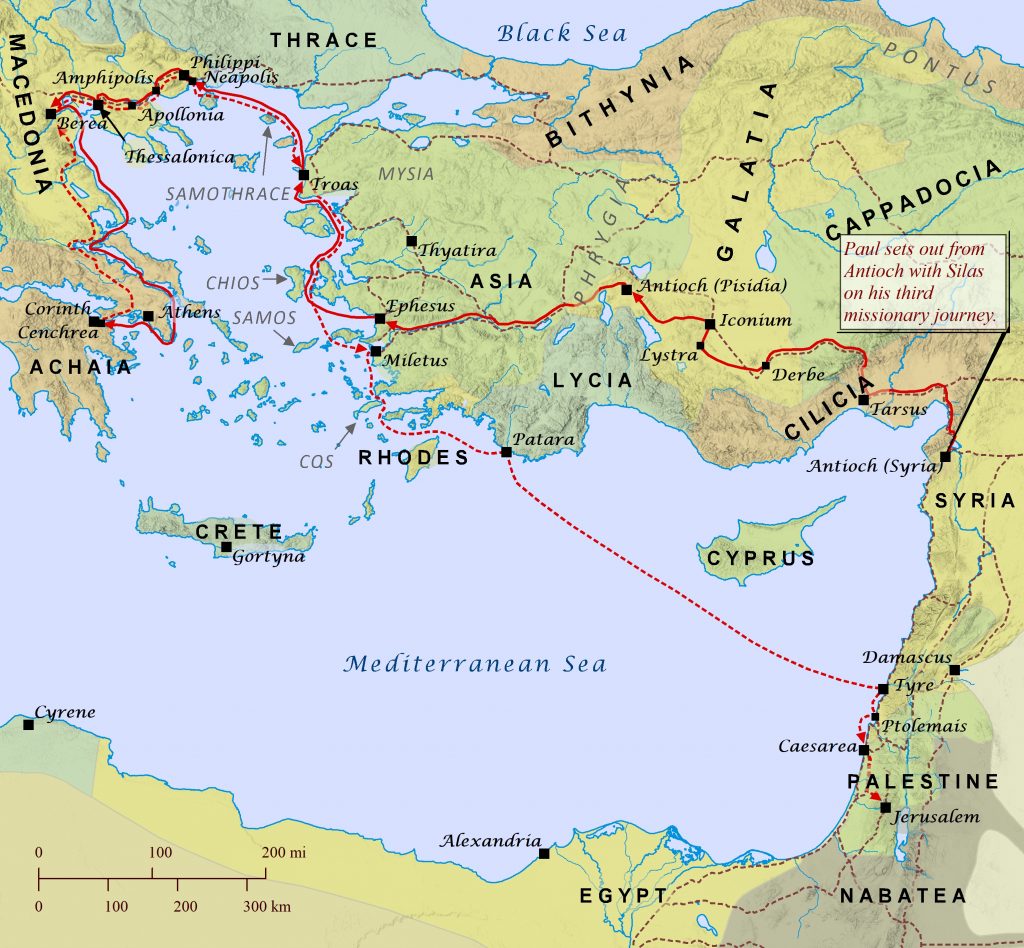
In the middle of Paul’s remarks we will look at this morning Paul tells us why he wants to give this speech, (v. 24) “if only I may finish my course and the ministry that I received from the Lord Jesus, to testify to the gospel of the grace of God.” He sees the end of his race of life quickly approaching, and he wants to finish well. Also, all of the other sermons in Acts are to lost people (Greeks, Jews, those in authority, etc.); this is the only recorded sermon in Acts to believers.[1]
To Finish the Race . . . Well (vv. 17-38)
Now from Miletus (MY_LEE_TUS) he sent to Ephesus and called the elders of the church to come to him.
Ephesus was thirty miles from Miletus and could be made in a single day of travel if they pushed it. The word elders is where we get the word presbyterian; later in verse 28 the same men are referred to as overseeers where we get the word bishop (episkopous) and in Titus 1:5, 7 Paul uses both terms elders, bishops and overseeers to refer the same office. These were not apostles, but what we refer to as pastors within the church of Ephesus.[2]
Paul realizes, through the inspiration of the Holy Spirit, that he is leaving all these churches that he has been apart of planting and establishing, and often would go back to revisit them to make sure they were ok, now he will more than likely never see them again – so he wants to speak to them, he wants to give them one last address. He wants to defend his life, he wants to explain why he has done things the way he has done them.
One Must Live an Honorable Life Before Others (vv. 18-23)
18 And when they came to him, he said to them: “You yourselves know how I lived among you the whole time from the first day that I set foot in Asia, 19 serving the Lord with all humility and with tears and with trials that happened to me through the plots of the Jews; 20 how I did not shrink from declaring to you anything that was profitable, and teaching you in public and from house to house, 21 testifying both to Jews and to Greeks of repentance toward God and of faith in our Lord Jesus Christ. 22 And now, behold, I am going to Jerusalem, constrained by the Spirit, not knowing what will happen to me there, 23 except that the Holy Spirit testifies to me in every city that imprisonment and afflictions await me.
Paul says from the first day that he set foot in their area, until now he served as a doulos, a slave for the Lord. Two attitudes mark a servant of the Lord; they serve with humility, and a willingness to endure suffering. Jesus suffered, the apostles suffered, Paul specifically suffered – those that lead and proclaim the truth of the gospel should expect to suffer.
Paul’s teaching had integrity, “teaching you in public and from house to house,” – if you were in a home, a private setting, he would teach the same as if he were on a platform teaching a crowd.
He has wept tears while he has served among them, and together they have endured trials. Together they have proclaimed and He has taught them of “repentance toward God and of faith in our Lord Jesus Christ,” This is gospel boiled down to its’ two essentials. Repentance; a turning away from sin and turning toward God, and Faith in Jesus Christ as Savior.
Paul “did not shrink from,” nautical phrase to let the sails down so that you slow down. He was as fast and full sail as possible. He knows that his next step is to go to Jerusalem and that imprisonment and affliction are waiting for him. Paul’s focus is not on staying alive, but on faithfully preaching the gospel – all the way until the end.
All of these “Musts” have a dark side – the opposite; the failure. For the honorable life, it is the dishonorable life. Specifically, here the truth teller has “shrunk back” from declaring things that are profitable, no teachings of repentance, or faith in Jesus as Lord. There would be divided messages for private talks, different from what was shared publicly. Testifying only to those who want to hear, and only saying what they want to hear.
One Must Teach the Truth Faithfully (vv. 24-27)
24 But I do not account my life of any value nor as precious to myself, if only I may finish my course and the ministry that I received from the Lord Jesus, to testify to the gospel of the grace of God. 25 And now, behold, I know that none of you among whom I have gone about proclaiming the kingdom will see my face again. 26 Therefore I testify to you this day that I am innocent of the blood of all, 27 for I did not shrink from declaring to you the whole counsel of God.
Paul has given his life to testify to the gospel, so that his life is of no value to him – it does not mean he has no value or that he wants to die, but that he prioritizes others and their hearing the gospel above himself.
(v. 27 “that I am innocent of the blood of all,” – Do we have a responsibility for the actions of other people? The Bible teaches that followers of God have a responsibility to tell others the truth (especially teachers). So, what happens when they don’t respond or accept it? Jesus taught the disciples to shake the dust from their feet when leaving an area that did not receive the gospel. It was a picture that the responsibility of what they were called to do had been done, but it was rejected. Matthew 10:14 “And if anyone will not receive you or listen to your words, shake off the dust from your feet when you leave that house or town.”
Ezekiel 3:16-18 “If I (God) say to the wicked, ‘You shall surely die,’ and you give him no warning, nor speak to warn the wicked from his wicked way, in order to save his life, that wicked person shall die for his iniquity, but his blood I will require at your hand. 19 But if you warn the wicked, and he does not turn from his wickedness, or from his wicked way, he shall die for his iniquity, but you will have delivered your soul.”
(v. 27) faithful leaders teach “the whole counsel of God ,” The dark side – they have shrunk back, they have lowered their sail, and have compromised the whole counsel of God. They teach what they think will make them look good, or not cause people to feel uneasy. Paul in a letter to his protégé Timothy said, “preach the word; be ready in season and out of season; reprove, rebuke, and exhort, with complete patience and teaching. 3 For the time is coming when people will not endure sound teaching, but having itching ears they will accumulate for themselves teachers to suit their own passions, 4 and will turn away from listening to the truth and wander off into myths.” 2 Timothy 4:2-4
The danger to the early church was not Jews who would oppose them, or leaders of governments who may seek to strike them – the most dangerous threat to the church has always been teachers from within who do not teach the whole counsel of the Word of God, and seek to be liked over telling the truth. John Milton called this “blind mouths.” “That is the tragedy that is possible to every minister of the Word; instead of seeing, he may be blind; instead of feeding, he may become merely a mouth desiring to be fed.”[3]
One Must Defend What Has Been Built (vv. 28-31)
28 Pay careful attention to yourselves and to all the flock, in which the Holy Spirit has made you overseers, to care for the church of God, which he obtained with his own blood.[4] 29 I know that after my departure fierce wolves will come in among you, not sparing the flock; 30 and from among your own selves will arise men speaking twisted things, to draw away the disciples after them. 31 Therefore be alert, remembering that for three years I did not cease night or day to admonish every one with tears.
(v. 28) Earlier Paul calls the spiritual leaders from Ephesus elders, but now he shifts to “” Elder focuses on the qualifications for the office, overseer focuses on what they do, the function of the office. Their function was to care for the flock – specifically by pay attention.
Paul tells them to watch themselves, and others because once Paul leaves, there will be people who will want to fill the leadership gap. In order to gather a following, they will say twisted things – Paul says, “I did not cease night or day to admonish every one with tears.” – “False teachers constantly attempted to tear down what he had built, often by attacking his credibility (2 Cor. 10:10-12; 11:1 ff.; Gal. 1:6-9; 3:1; 5:12; Phil. 3:2).”[5]
Paul taught the church for three years, day and night, with tears. “Whenever the truth is proclaimed, Satan can be expected to counter it with the lies of false doctrine.”[6] Church first, you must be aware that lies are constantly trying to creep in. And once they are in it causes division, people want to build their little kingdoms, and it destroys churches. Paul is crying (admonishing with tears) because of the consequences if false doctrine makes its way into the church.
Revelation 2:2-4 Jesus says to the church at Ephesus, “‘I know your works, your toil and your patient endurance, and how you cannot bear with those who are evil, but have tested those who call themselves apostles and are not, and found them to be false. 3 I know you are enduring patiently and bearing up for my name’s sake, and you have not grown weary. 4 But I have this against you, that you have abandoned the love you had at first.”
In the years of fighting for the truth, and fighting off men who would say twisted things, and try to build their own little kingdoms, their hearts would eventually grow cold toward the gospel and people receiving Christ. Even some of their number had been dragged or carried of by these false teaching wolves. They were faithful to serve, but they would eventually do it with a cold heart. So, defend the truth but watch your heart.
The dark side – The Teacher stops paying attention (you become distracted from your calling or just get tired of the fight), Something causes your gaze to move from the horizon where the wolves, hyenas, and thieves stay to other things. Sin creeps into your own life, and you stop paying attention to truth among the flock, and the gate opens and the wolves can come in and carry off and devour the sheep.
The is the difference between a person serving from a sense of calling (by the Holy Spirit), and the person who is a hired worker (only focused on what they are getting out of it). John 10:12 “He who is a hired hand and not a shepherd, who does not own the sheep, sees the wolf coming and leaves the sheep and flees, and the wolf snatches them and scatters them. 13 He flees because he is a hired hand and cares nothing for the sheep.” Jesus is the good shepherd, leaders (specifically pastors) serve as under-shepherds. Jesus laid down his life for the sheep, so should those who are called to be shepherds.
One Must Work Hard and Make Sacrifices For the Work (vv. 32-35)
32 And now I commend you to God and to the word of his grace, which is able to build you up and to give you the inheritance among all those who are sanctified. 33 I coveted no one’s silver or gold or apparel. 34 You yourselves know that these hands ministered to my necessities and to those who were with me. 35 In all things I have shown you that by working hard in this way we must help the weak and remember the words of the Lord Jesus, how he himself said, ‘It is more blessed to give than to receive.’”[7]
(v. 35) “I have shown you that by working hard,” – Paul regularly referred to the act of Christian ministry as labor. Paul makes it plain, that those that seek to serv ethe Lord must be laborers (1 Timothy 5:18), hard workers, in particular in their labor of preaching and teaching (1 Timothy 4:13–16; 5:17). They are to do the labor of teaching, and then live out a life before the people a life based on that same teaching. 2 Timothy 2:15 “Do your best to present yourself to God as one approved,3 a worker who has no need to be ashamed, rightly handling the word of truth.”
“‘It is more blessed to give than to receive,” – This summarizes all of Paul’s instructions, “In a nutshell, their ministry was to be one of giving. Paul gave himself to God and his people. He gave himself to the ministry of the Word. To finish the race set before us we must understand that a ministry that honors God is focused on giving, not getting something in return. Paul gave his life so that others can hear the gospel.[8] Paul has called this group of pastors together, so when their congregants see these leaders suffering for the sake of the gospel, then they will be more willing to suffer and sacrifice as well.
One Must Let Go (vv. 36-38)
36 And when he had said these things, he knelt down and prayed with them all. 37 And there was much weeping on the part of all; they embraced Paul and kissed him, 38 being sorrowful most of all because of the word he had spoken, that they would not see his face again. And they accompanied him to the ship.
The church in Antioch, before the first missionary journey, could have held on to Paul and Barnabas – they could have demanded that they stay am remain teachers for them. But, no, when the Holy Spirit directed, they laid hands on them and sent them of on their missionary journey.
Paul could have tried to control all the churches that he planted – like some kind of multi-site early mega church – but he doesn’t. In Titus 1:5 Paul tells Timothy “This is why I left you in Crete, so that you might put what remained into order, and appoint elders in every town as I directed you.” Paul was apart of planting and building ministries and churches, then he hands them off to pastors to lead them.
Why the elders of Ephesus? Paul’s pattern of ministry, as an apostle, was to share the gospel, gather those who believe and instruct them for a period of time. Even coming back to check on them, and writing them letters with correction or encouragement. At a certain point leaders would be put in place, and the churches would grow and multiply. By giving this instruction to the elders, he is letting go of these churches, and entrusting the church to their leadership.
Conclusion
It should be the goal of every Christian to successfully complete the ministry God has given them. To do this you begin with the end in mind – every day we plan out how we will do what God has called us to do.
___________________
[1] R. C. Sproul, Acts: An Expositional Commentary (Fanford, Florida; Ligonier Ministries, 2019) 308.
[2] Archibald Thomas Robertson, Word Pictures In The New Testament, Volume III (Nashville, Tennessee; Broadman Press, 1930) 346.
[3] G. Campbell Morgan, The Acts of the Apostles (Old Tappan, New Jersey; Fleming H. Revell Company, 1924) 473.
[4] Reference to the Trinity – Holy Spirit appointed, the church is the Father’s, redeemed by the blood of the Son.
[5] John MacArthur, The MacArthur New Testament Commentary, Acts 13-28 (Chicago, Illinois; Moody Publishers, 1996) 209.
[6] MacArthur, 226.
[7] This saying is not mentioned in the gospels, but Paul references it as a saying Jesus was known to say. This indicated that not everything Jesus said and did were in the gospels. See John 21:25.
[8] Ephesians 4:28 “Let the thief no longer steal, but rather let him labor, doing honest work with his own hands, so that he may have something to share with anyone in need.”
“A Summer Journey;
Following the Apostle Paul Through His Missionary Journeys”
A Sermon Series
“Introductions to the Unknown God”
Acts 17:22-34
Introduction
On Paul’s second missionary journey we follow him into the city of Athens. Escaping from Thessalonica and Berea, he is awaiting his fellow missionaries (Timothy and Silas). He is making his way through the city.
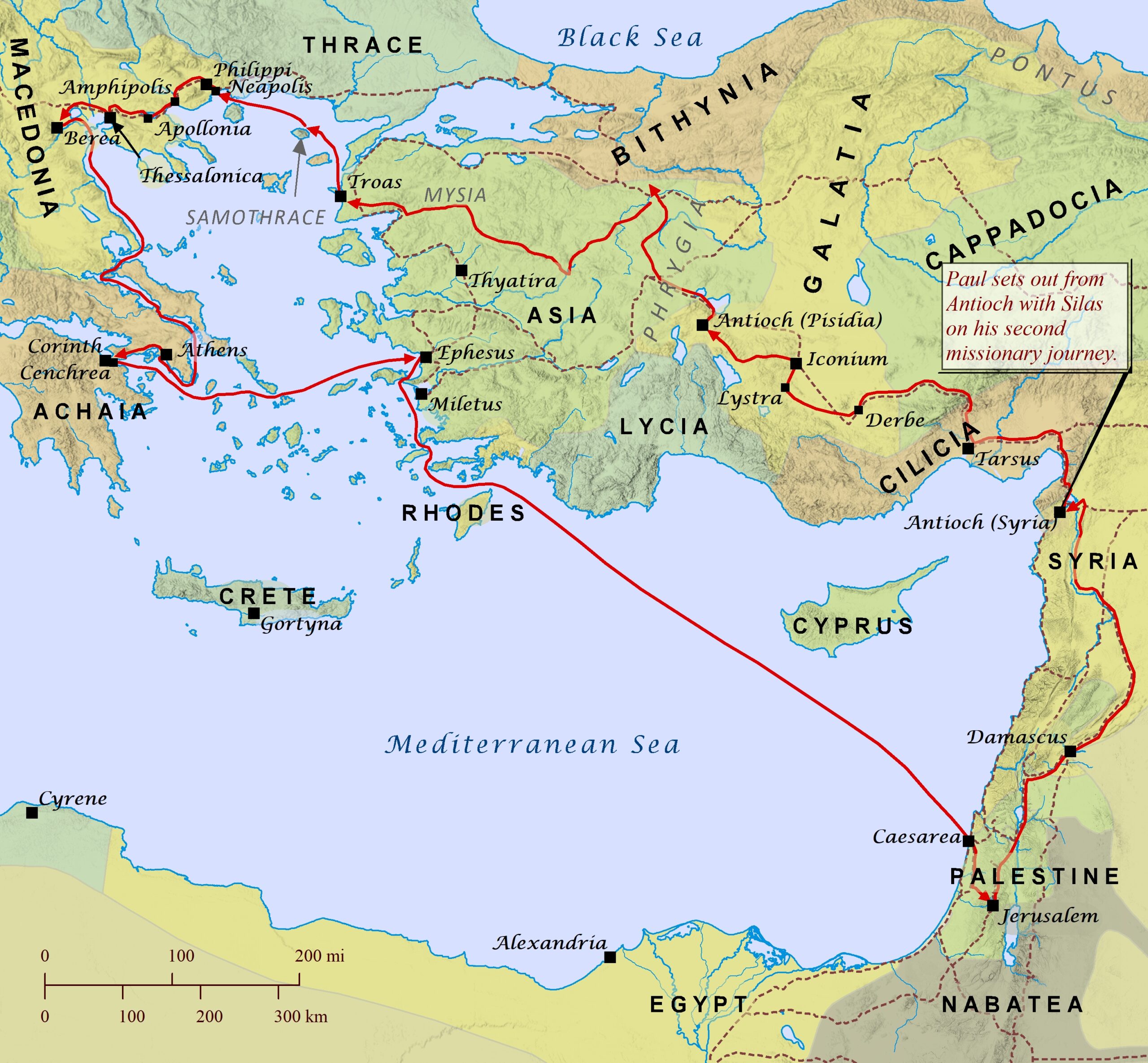
“As a Hellenized Jew, Paul had been exposed to Greek culture with its outstanding traditions in art and philosophy. Athens was the center of that culture. In its heyday, several centuries before Christ, it had been the greatest city in the world. Socrates, his brilliant student Plato, and Plato’s student Aristotle, perhaps the greatest philosopher of all time, taught there.”[1]
Along with this rich academic culture, Athens was also a religious center, where almost every god thought to exist was worshipped. A pagan writer named Petronius sarcastically said that it was easier to find a god in Athens than a man. Every public building was dedicated to god, and statues of gods were everywhere. So, while Paul is waiting, he begins to go into the Jewish synagogues and explaining how Jesus was the Messiah. The Jewish people, in their jealousy, bring Paul before the Roman authorities there in Athens, and there the Roman leaders ask him what he is teaching,
Acts 17:19-21 “And they took him and brought him to the Areopagus, saying, “May we know what this new teaching is that you are presenting? 20 For you bring some strange things to our ears. We wish to know therefore what these things mean.” 21 Now all the Athenians and the foreigners who lived there would spend their time in nothing except telling or hearing something new.”
Understanding That God Is (vv. 22-26)
22 So Paul, standing in the midst of the Areopagus, said: “Men of Athens, I perceive that in every way you are very religious.[2] 23 For as I passed along and observed the objects of your worship, I found also an altar with this inscription: ‘To the unknown god.’ What therefore you worship as unknown, this I proclaim to you.
Hebrews 11:6 “And without faith it is impossible to please him, for whoever would draw near to God must believe that he exists and that he rewards those who seek him.” The Bible intent is not prove that God exists, there also is no scientific experiment or mathematical equations you can do to prove God exists – however it does say things like:
Psalm 19:1 “The heavens declare the glory of God, and the sky above proclaims his handiwork. 2 Day to day pours out speech, and night to night reveals knowledge.”
Romans 1:19-20 “For what can be known about God is plain to them, because God has shown it to them. 20 For his invisible attributes, namely, his eternal power and divine nature, have been clearly perceived, ever since the creation of the world, in the things that have been made.”[3]
Theologians call this the cosmological argument (cause and effect) – everything comes from something (a cause), and if you go back far enough there is an original cause (God as creator). Hebrews 3:4 “For every house is built by someone, but the builder of all things is God.”[4]
https://www.youtube.com/watch?v=ilgdFvit49Y
Paul points out one of their alters, “with this inscription: ‘To the unknown god.’” “Their thinking was that if the gods were nor properly venerated they would strike the city. Hence, lest they inadvertently invoke the wrath of some god in their ignorance of him or her, the city set up these alters to unknown gods (Diogenes 1.110-113).”[5] Paul then says, “You don’t know this God, but I do, and I would like to tell you about this God.
By saying, “What therefore you worship as unknown, this I proclaim to you,” Paul is not saying that God accepted this worship; the emphasis is on the ignorance, not the worship.[6] “You have been worshipping a god that you do not know” – There has to be a knowledge of God, a personal relationship with Him before our worship can ever be accepted by God. That knowledge of God comes through our relationship with Jesus Christ.
Later on, there will people who see Paul’s miracles and try to do the things they saw Paul doing, but it is separate from a relationship with God. They try to use the name of Jesus apart from a relationship with Jesus – Acts 19:13-16 “Then some of the itinerant Jewish exorcists undertook to invoke the name of the Lord Jesus over those who had evil spirits, saying, “I adjure you by the Jesus whom Paul proclaims.” 14 Seven sons of a Jewish high priest named Sceva were doing this. 15 But the evil spirit answered them, “Jesus I know, and Paul I recognize, but who are you?” 16 And the man in whom was the evil spirit leaped on them, mastered all of them and overpowered them, so that they fled out of that house naked and wounded.”
Even the demons knew that they were not followers of Jesus. The Athenians admit they don’t know this god, it’s in the title “unknown god,” built the alter to the unknown god because they did not want this God’s fury – but it is their lack of knowing Him, that will in the end bring judgement upon them.
Understanding God begins with a belief that a God exists, but then we have to ask “What is He like?” It is the tendency of all of humanity, that once we believe there is a God, to then make him into our own image – We think to ourselves, god is like me. So we mold him and craft him to be what we want him to be like – we call this idolatry. So, Paul then goes on to explain what God is like:
24 The God who made the world and everything in it, being Lord of heaven and earth, does not live in temples made by man, 25 nor is he served by human hands, as though he needed anything, since he himself gives to all mankind life and breath and everything. 26 And he made from one man every nation of mankind to live on all the face of the earth, having determined allotted periods and the boundaries of their dwelling place,
The God that Paul is talking about created everything that exists (including the heaven and the earth). He is all powerful and does not need anything (He is completely self-sufficient). We need God to give us breath and life, and it was God who gave us our original source of being (Adam). Our lives of breath have also been allotted out and measured by this unknown God – He determines when you are born, where you are born, to whom you are born, and how many breaths you will take on this earth.
A source of pride by the Athenians was that they were above everyone, and everyone else were barbarians. “All men are equal, because all were created by God.”[7] “The unity of the human race as descended from Adam is fundamental in Paul theology, (Rom. 5:12).”[8] We are equal before God, and we are equal in that we are all sinners.
What is this unknown God like? He creates, he sustains His creation, He is all powerful, He is gives purpose (allotted times, boundaries, dwelling places, etc.) You were born into this world for “such a time as this,” you are given boundaries and purpose. God gives you life and breath “and everything” for a purpose, and your time here is measured. You are not to make your own path, you are not your own creation – Your Creator has intentionally put a path before you. When you meet this unknown God, you discover your life’s purpose.
Understanding Who Go Is (vv. 27-29)
27 that they should seek God, and perhaps feel their way toward him and find him. Yet he is actually not far from each one of us, 28 for “‘In him we live and move and have our being’; as even some of your own poets have said, “‘For we are indeed his offspring.’ 29 Being then God’s offspring, we ought not to think that the divine being is like gold or silver or stone, an image formed by the art and imagination of man.
Our life’s purpose is to have a relationship with God. (v. 27) “that they should seek God, and perhaps feel their way toward him and find him,” This is a picture of “the blind groping of the darkened heathen mind after God to “find him” whom they had lost. One knows what it is in a darkened room to fell along the walls for the door.”[9] Each of the 30,000 statues of gods, and hundreds of temples to gods, all here man’s attempt to find god. But God is not far off from any person, “he is actually not far from each one of us.”
Realizing, through natural revelation, that there is a God, and this God has reached out to humanity and desires to have a relationship with them. Even the Athenian poets recognized this truth, “For we are indeed his offspring.”
(v. 28) Paul quotes a saying of their day, “In him we live and move and have our being’” – In a godless society people are taught that the beginning of time was meaningless (just a cosmic chaos of elements swirling into something existing), and that time ends in eternal nothingness (elements decaying into the earth).
According to the godless world view, we start and end in meaninglessness. What Paul is telling the world is that life is rooted and grounded in God.[10] You live because of God, your path is laid out before you because of God, and your very being (existence) is because of God – and that all-powerful God wants a relationship with you.
Without the light of Jesus, humanity groped along in spiritual darkness and came up with all kinds of false gods – but now that Jesus has arrived, He is the light of the world – Jesus allows us to see who God truly is, what God is like, and how to have a relationship with Him.
Understanding What God Has Said (vv. 30-31)
30 The times of ignorance God overlooked, but know he commands all people everywhere to repent, 31 because he has fixed a day on which he will judge the world in righteousness by a man whom he has appointed; and of this he has given assurance to all by raising him from the dead.”
If a person observes nature around him and comes to the understanding that there is a creator God (a first cause). This is not enough to lead to a saving knowledge of God. God has to reveal himself to the world – and He has done this through Jesus Christ. When Jesus came, it marked a change in how God deals with mankind. Based on the revelation of Jesus to humanity, we must repent of our sin and put our faith in Him.
John 5:22, 27 “For the Father judges no one, but has given all judgment to the Son, 23 that all may honor the Son, just as they honor the Father. . . 27 And he has given him authority to execute judgment, because he is the Son of Man.”
“Something changed dramatically in the course of human history, something that is not just for the Jews but for Athenians, Romans, and Philippians and every person in the world. Now God commands all men everywhere to repent.”[11]
Why the change now that Jesus has been revealed? “because he has fixed a day on which he will judge the world.” – Judgement Day is approaching. To prove that Jesus is the one who will ultimately judge the world based on God’s standard of righteousness, Jesus was raised from the dead.
The knowledge that is revealed through creation, then further explained through the revelation of Jesus, requires a decision – there is always a call to do something with Jesus. What you do with Jesus ultimately determines where we will live, where we move, and where we will have our being.
Understanding That All Have a Decision to Make (vv. 32-34)
32 Now when they heard of the resurrection of the dead, some mocked. But others said, “We will hear you again about this.” 33 So Paul went out from their midst. 34 But some men joined him and believed, among whom also were Dionysius the Areopagite and a woman named Damaris and others with them.
Paul standing amongst all the temples and statues and buildings dedicated to false gods, says, “there is but one God, He has sent His Son to save the world from their sins, and He will return on an appointed day to judge the world based on His standard of righteousness. Do you want to know him?”
When Paul had finished his sermon, there were three responses. One group was fine with novel and new thought, but when it arrived at the resurrection from the dead, they mocked. The second group said. “We will hear you again about this.”. That’s enough truth for one day.” Which is the person who hears the sermon but doesn’t do anything with it. And there were some who believed and even joined them in the missionary journey. They now know the unknown God. Would you like to meet Him today?
___________________
[1] John MacArthur, Macarthur New Testament Commentary Series, Acts (Chicago, Illinois; Moody Publishers, 1996) 129.
[2] Capitatio benevolentiae – a rhetorical technique used in an effort to win the favor of his hearers and thus secure their attention at the beginning of a speech.
[3] Sensus divinatatus – within every person is a knowledge that there is a God (while we may try to suppress it).
[4] This is called the teleological argument; the order and complexity of the universe could not have arisen out of random chance. The house has to have a builder.
[5] Ajith Fernando, The NIV Application Commentary, Acts (Grand Rapids, Michigan; Zondervan Publishing, 1998) 475.
[6] Fernando, 480.
[7] MacArthur, 140.
[8] F. F. Bruce, The Acts of the Apostles, The Greek Text With Introduction and Commentary (Grand Rapids, Michigan; WM. B. Eerdmans Publishing Company, 1979) 337.
[9] Archibald Thomas Robertson, Word Pictures In The New Testament, Volume III (Nashville, Tennessee; Broadman Press, 1930) 288.
[10] R.C. Sproul, Acts, An Expositional Commentary (Sanford, Florida; Ligonier Ministries, 2019) 279.
[11] Sproul, 281.